

A century ago, Dallas was more of a small trading post. However, by the early 20th century, the city was already home to many very wealthy families. While it’s hard to compare the value of money then and now, a fortune of a quarter-million dollars made someone genuinely wealthy in an era when even indoor plumbing was a luxury. Many of these affluent families still live in Dallas today, maintaining their influence and long-held traditions. It’s a unique aspect of the city, where local roots have remained remarkably strong through generations. These families take special pride in being part of Dallas’s foundational history. More at dallaski.com.
How Did Dallas’s First Settlers Build Their Fortunes?
In the early 20th century, Dallas had evolved from a small trading post into a city with a number of very affluent families. These early fortunes were built by people who weren’t afraid to put down roots in a town that seemingly lacked natural advantages like a harbor or gold mines. Dallas’s founders, such as John Neely Bryan, were true masters of promotion—they weren’t shy about embellishing a bit to attract new settlers.
Whether people believed the hype or not, the settlers came. For many who stayed, the decision proved to be highly profitable. Some took up farming on the fertile soil or raised cattle on vast nearby ranches. Others thrived by providing essential services, such as making saddles, selling dry goods, or ferrying people across the Trinity River. But the primary commodity in Dallas has always been, and arguably still is, land. Those who invested in real estate became wealthy very quickly.
Dallas Dynasties of the Early 20th Century
In the early 20th century, Dallas was shaped by powerful families whose wealth and influence laid the groundwork for the city’s growth. Let’s look at a few of them.
The Cockrell family is considered Dallas’s oldest dynasty, and interestingly, its fortune was largely amassed by a woman: Sarah Horton Cockrell. She and her husband, Alexander, purchased John Neely Bryan’s unsold land plots and the ferry franchise. After her husband’s tragic death, Sarah single-handedly continued the family businesses while adding many of her own ventures. She successfully managed the first steam-powered sawmill, a brickyard, and a construction business, and she also built a toll bridge across the Trinity River and a three-story hotel. Even when her husband was killed and the wooden bridge he built collapsed, Sarah did not give up. She secured a charter to build a new bridge despite opposition from local businessmen and even addressed the state legislature in person, becoming the first woman in Texas to do so. Her real estate holdings were so vast that her will was printed on 24 pages.
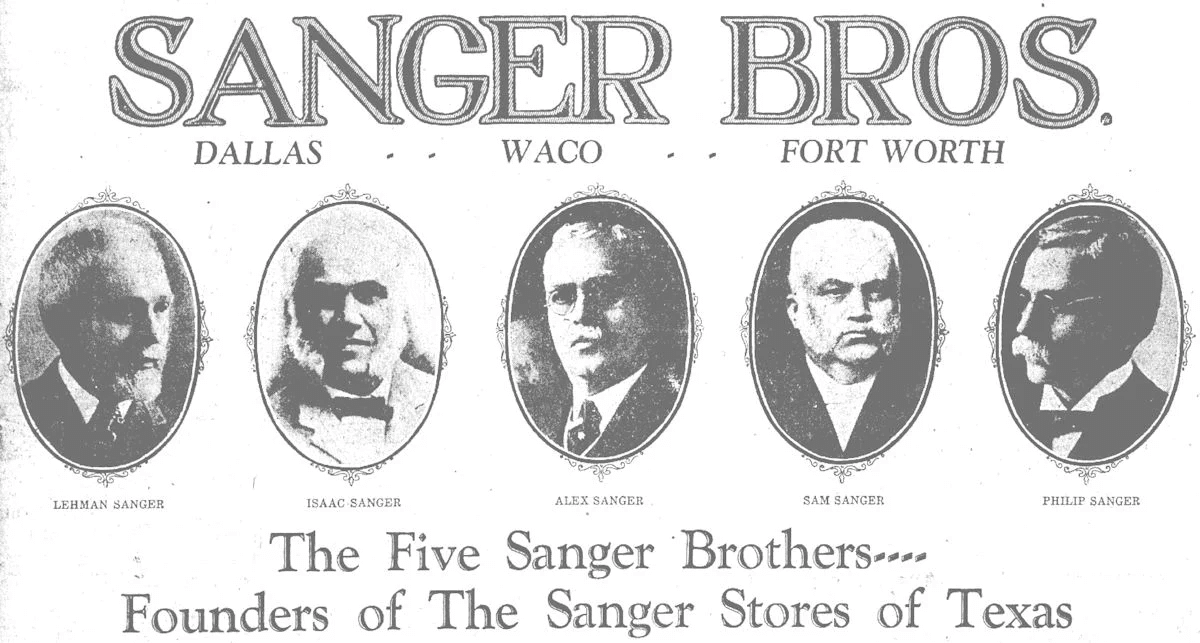
Another influential family was the Sangers. The five Sanger brothers immigrated from Bavaria in the 1850s and all went into the retail trade. In 1872, they arrived in Dallas and focused their efforts on developing the Sanger Bros. department store. By the 1890s, their business was generating $3 million annually. Brothers Philip and Alex Sanger lived lavishly, building ostentatious mansions in the prestigious neighborhood known as The Cedars. Their homes were true works of art, as no expense was spared in importing furniture and decor. Philip’s daughter, Lois, married into another prominent Dallas family—the Linzes, founders of a well-known jewelry store.
The Schoellkopf family is also noteworthy. Their fortune began in 1869 when Gottlieb Heinrich Schoellkopf founded the G.H. Schoellkopf Company, which for a long time was the only saddlery in the state. When the horse gave way to the automobile, the company diversified its operations. Descendants like Buddy Schoellkopf continued to grow the family business, expanding into sporting goods and charter helicopter services.